
Noble County Court Record Requests
Noble County has two recordkeeping paths. The Noble County Clerk of Courts holds Common Pleas records. Those cover the CaseLook categories marked Appeals, Civil, Criminal, Domestic Relations, Judgment Lien, and Miscellaneous. The Noble County Court clerk, in turn, keeps County Court records. They include traffic, misdemeanor criminal, civil, small claims, and parking matters. A village name alone will not pick the court. Noble County has no municipal court. Before you request anything, decide two things. Which court heard the matter, Common Pleas or County Court? And what exactly do you need: a docket, a filed paper, a journal entry, an order, a recording, a transcript, a regular copy, or a certified copy?
- Use the correct Noble County CaseLook system to identify the numeric case or ticket number, court category, and any useful event date.
- Ask the clerk for the specific item, not merely “the record.” State whether a regular or certified copy is needed and provide the known date or event.
- For Common Pleas, contact the Clerk of Courts at 740-732-4408 or areiter@noblecountyohio.gov, or visit during published business hours. For County Court, call 740-732-5795 or visit its office.
- Confirm the price, payment method, delivery or pickup option, processing time, and any restriction before paying. Those details are not fully published for each court.
- Use a specific written request to the proper custodian when a noncase public record or an access issue calls for a formal request.
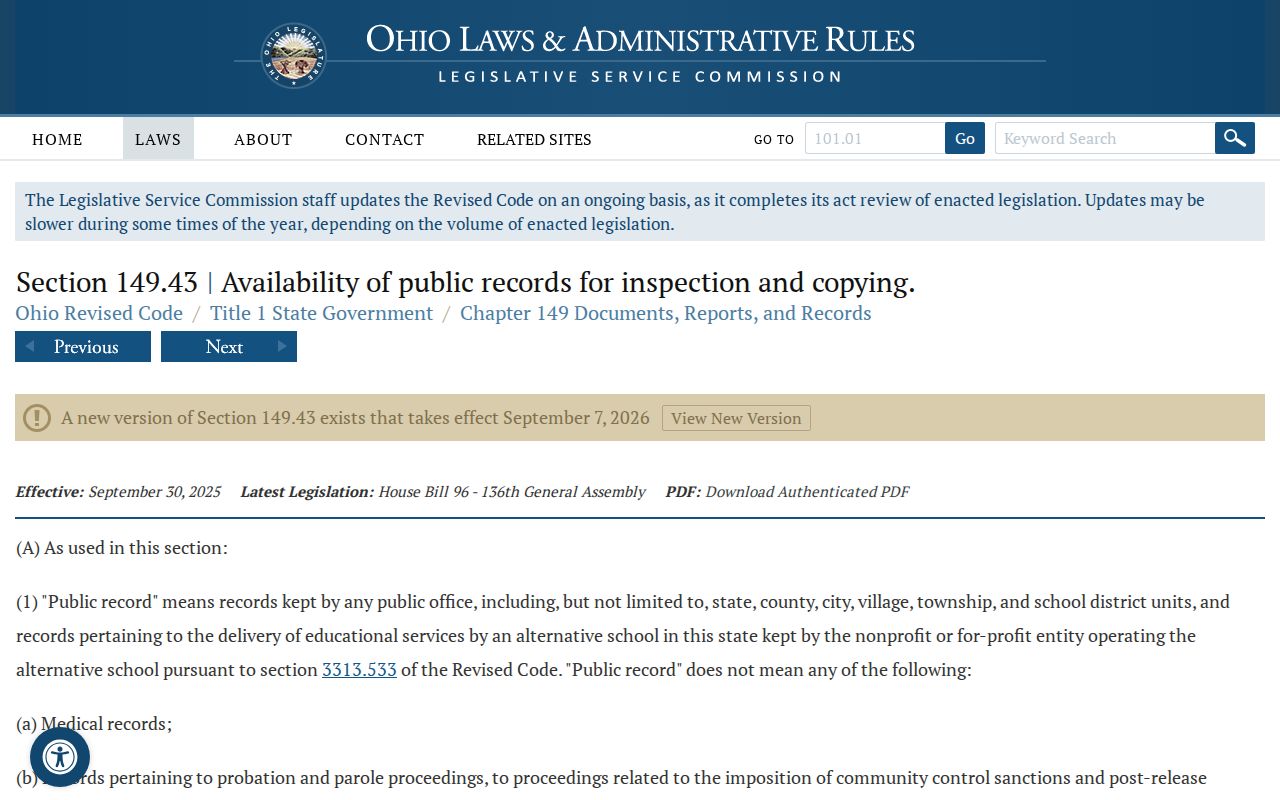
Ohio's public-record law, R.C. 149.43, sets the ground rules. A requester does not have to give a name or a reason to see a record. If a written request is denied, the office holding the record must hand over a written explanation with the legal authority behind the denial.
Put any written request in terms of the specific record and the Noble County office that holds it. Neither CaseLook system, by itself, is the complete request channel.
Noble County Verified Record Requests
The Common Pleas CaseLook notice carries strong warnings. Displayed records are current only within the retrieval system's limits. They may lag filings or judicial action by at least 24 hours or longer. Entries can change without notice. The court calls the display unverified information. It points requesters to the court itself, or a visit during regular business hours, as the fallback. For an urgent or official Common Pleas record, trust neither a screen capture nor the absence of a new entry.
The Common Pleas court lists its clerk at 350 Court House, Caldwell, OH 43724. The number is 740-732-4408. A Seventh District directory gives the same clerk function and number. But it describes the location as 350 Courthouse Square. That street-label difference appears in the official sources. If a particular counter or delivery instruction matters, call ahead. County Court's verified-record route runs through its clerk office at 100 CourtHouse Square, Caldwell. That number is 740-732-5795.
Neither clerk publishes mail, fax, drop-box, identity-document, email, payment, or turnaround rules for ordinary court-record submissions. Do not promise yourself any of those procedures. The relevant clerk confirms them when asked.
Note: A CaseLook display can locate a Noble County record. The court or clerk supplies the verified information.
Kinds of Court Records
A Noble County docket result, the court journal, and the case file are three different things. County Court Local Rule 1.04 spells this out. It requires separate civil, trusteeship, and criminal dockets. It also calls for a separate journal of written, signed orders, plus a distinct file for each case. The public CaseLook systems work well as index and chronology tools. What they do not prove is that every filing image is available remotely. Nor do they show that a printout carries the clerk's certification.
- Docket or trial docket: a serial chronological record with case number, title, filing date, and the nature of the charge or claim.
- Journal entry: a written, signed order entered on the journal rather than an oral courtroom event.
- Case file: the individual papers and documents filed in a particular matter.
- Regular copy: a standard clerk copy, distinct from the public online display.
- Certified copy: a clerk-issued official copy for a purpose that requires court certification.
- Recording or transcript: a separate request route that can involve a court reporter and additional expense.
For that court's local rules, the official access point is the Common Pleas local-rules page. It covers court procedure only. It is not a portal for downloading public documents.
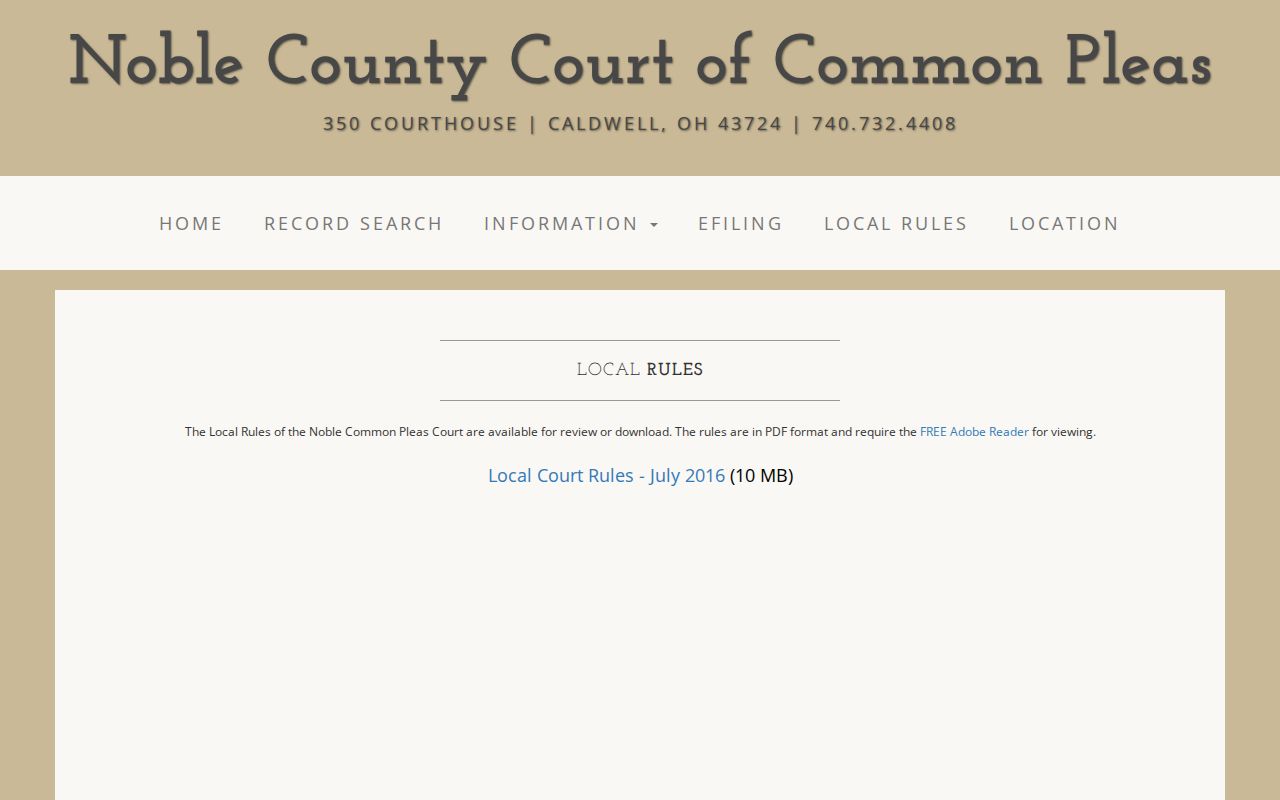
Local rules explain how a court maintains its records. The relevant Noble County clerk decides how an available copy can be requested.
Noble County Docket, Journal, and File
Knowing the local record names sharpens a Noble County request. County Court's rule keeps the serial docket separate from the journal and the case file. The criminal trial docket may sit on separate sheets or live electronically. A CaseLook search can point you to a case number and a sequence of action. It cannot turn the online display into the signed order. It also cannot produce every paper in the file.
Noble County Court's history and jurisdiction page traces the court to its first elected judge in 1958. It also confirms the county has no municipal court. That history explains a practical point about docket and record requests. Lower-court matters from the villages all reach one County Court clerk. They do not go to several municipal recordkeepers.
- Docket
- The chronological court register of filings, orders, settings, and other action in one matter.
- Journal entry
- A written order signed by the judge and entered on the journal.
- Case file
- The separate collection of documents filed in the individual case.
- Certified copy
- A clerk-certified copy, distinct from a web display or ordinary printout.
In a Common Pleas case, CaseLook may surface the category and number before you approach the Clerk of Courts. In a County Court matter, the County Court CaseLook number and category steer the clerk to the serial record. Neither system supports a claim that all filed images are public online.
Note: Name the docket, journal entry, or document you need before asking a Noble County clerk for a copy.
Court Records: What They Contain
County Court rules describe what a docket holds: the serial case number and title, the filing date, and the nature of the charge or claim. They treat signed orders in the journal and papers in the individual file as separate records. What a particular request actually yields depends on the court, the record type, and any access restriction that applies.
| Case number | The court’s numeric identifier. The inspected CaseLook number fields say numbers only. |
|---|---|
| Case title or caption | The title associated with the docket; no individual case data is reproduced here. |
| Filing date | A required County Court docket item marking when the matter was filed. |
| Charge or claim nature | The basic case description kept in the County Court docket, subject to limits on public access. |
| Journal entry | A written, signed order kept separately from the docket list. |
| Filed documents | Pleadings, motions, exhibits, and other papers in the individual case file, when access is permitted. |
A docket lists what happened and when. It does not hand you the paper itself. When you need a specific filed document in Noble County, note its name and date, then ask the clerk for that item instead of relying on a generic CaseLook result.
Noble County eFiling Is Not Record Access
The Common Pleas site links to Henschen & Associates eFiling. Registering or signing in there lets a filer submit documents electronically. That route serves filers, not the public. It is not a free document-imaging service. It offers no certified-copy channel and no way around a court-record restriction. For public searches, the separately branded CaseLook systems are the tools. Turn to eFiling only when the court directs a party or lawyer to file. Everything else goes through a clerk.
For a Noble County public lookup, use CaseLook. When you need a verified document, journal entry, or certification, ask the clerk that keeps the case. That means the Common Pleas Clerk of Courts or the County Court clerk. Neither publishes a Common Pleas copy-fee schedule, an image-access price, a certified-copy order form, or a stated processing time. Note: an eFiling account is a filing credential. It is not proof that a particular Noble County document is available to the public online.
Copy Fees and Certification
The Noble County Court costs page posts copy charges effective February 1, 2026. Regular copies run 25 cents per page. Certified copies run $1 per page. There is also a $15 certificate of judgment charge. Those are County Court prices only, so do not transfer them to Common Pleas, which publishes no official copy-fee schedule.
| County Court Item | Published Amount | Request Note |
|---|---|---|
| Regular copy | $0.25 per page | Confirm the page count and payment method with the clerk. |
| Certified copy | $1.00 per page | Ask whether this is the needed certification for the intended purpose. |
| Certificate of judgment | $15.00 | Published as a separate County Court cost line. |
| Common Pleas copy or certification | Fee not located in official sources | Contact the Noble County Clerk of Courts before submitting a request. |
Noble County Court Clerk
100 CourtHouse Square
Caldwell, OH 43724
740-732-5795
Certification is a clerk's job. A Noble County CaseLook printout is not described as a certified copy.
Noble County Transcript and Docket Requests
A transcript request is not a Noble County docket request. County Court rules say matters are recorded on tape or digitally. Authorized court reporters may remove recordings. Transcription comes at the requesting party's expense. Recordings are stored for one year after trial or hearing. A longer period is possible if requested. Before you ask, figure out what you need. It might be a docket list, a filed paper, a signed journal entry, a recording, or a transcript.
| Requested Item | Local Record Route | Important Difference |
|---|---|---|
| CaseLook docket information | Appropriate Noble County CaseLook system | Searchable electronic information can lag and is not verified. |
| Filed document or journal entry | Clerk who keeps the court file | The clerk must confirm access, copy cost, and certification. |
| Recording or transcript | County Court recording or court-reporter route | Transcription can carry a separate requesting-party expense. |
That one-year retention rule covers County Court recordings only. It says nothing about every Noble County court file. Nor does it limit which historic records exist. Note: ask whether your request concerns a clerk-held document or a separately handled recording before expecting a normal copy process.
Access Rules for Court Records
Ohio's access rules sit in one place. They are Rules of Superintendence 11.09 through 11.16, renumbered on July 1, 2026. Together they set the public-access framework for court records. Direct access and remote access are not the same thing. A missing online document does not prove a case is missing, and both Noble County CaseLook notices send people needing verified information to the court or clerk.
Ohio court-record access rules: Sup.R. 11.10 presumes public access unless a rule, law, or order restricts it. Sup.R. 11.11 and 11.12 address direct and remote access, while Sup.R. 11.13 and 11.14 cover personal identifiers and restriction procedures. R.C. 149.43 supplies the written-request and written-denial framework for public records.
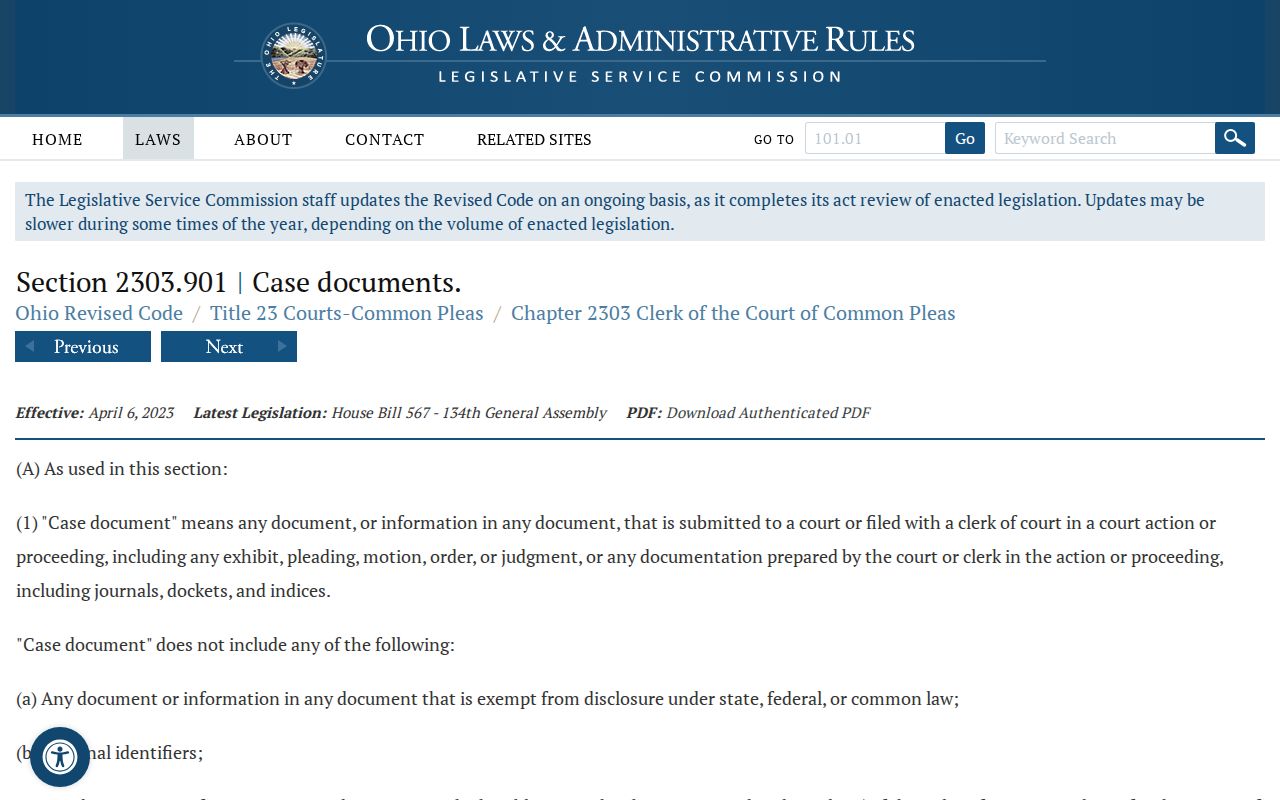
Another statute matters here. R.C. 2303.901 addresses omitted personal identifiers and restricted Common Pleas documents, and sealed, protected, juvenile, or identifier-redacted material may not be released through a public search or a regular copy request.
A Noble County search result never overrides a court restriction or a sealing order.
Noble County Record Restrictions and Forms
The Noble County Court forms page links to a sealing memorandum, a Written Plea of Not Guilty, parking-appeal forms, eviction forms, and supervision forms. None of that creates a universal online record-request process. Nor do the scans settle sealing eligibility. They cannot promise access to a restricted file either. Ask the relevant clerk about current forms, procedures, and permitted access.
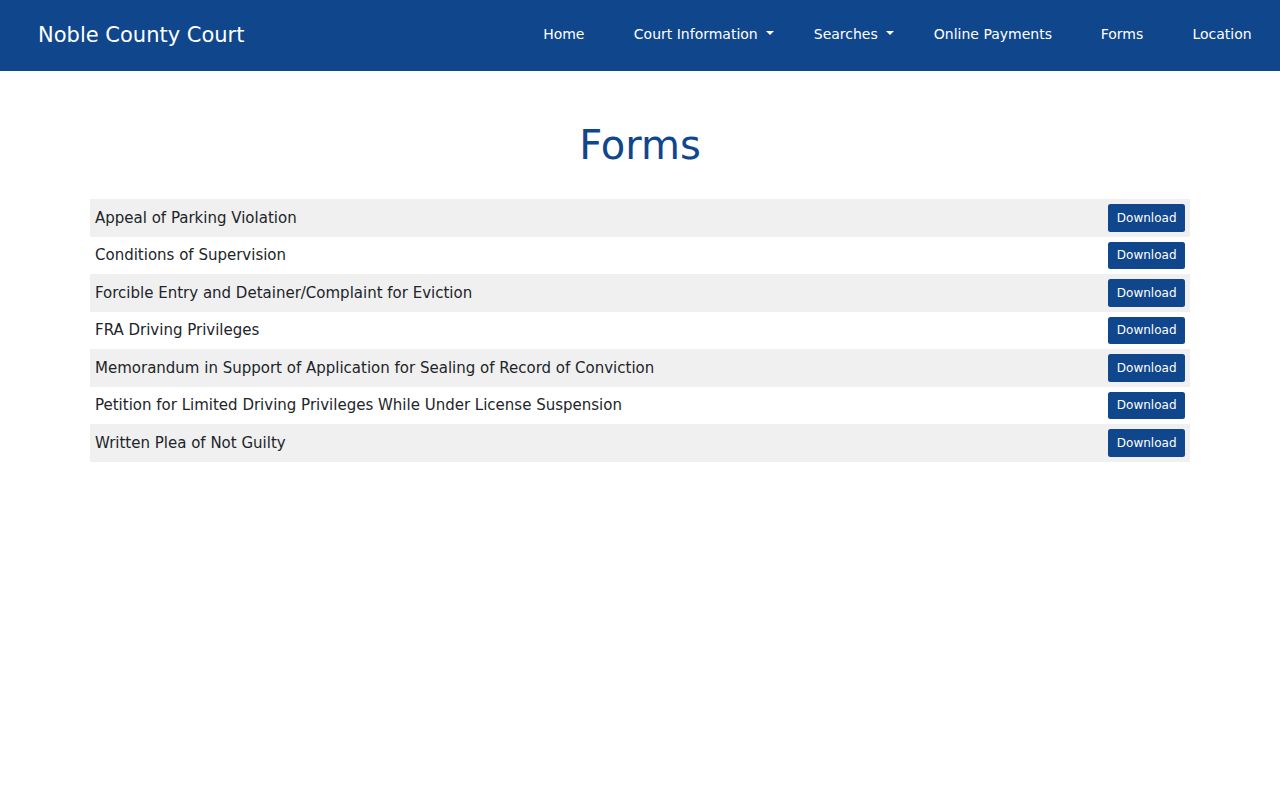
The forms page points toward official paperwork. A Noble County records request still needs the right clerk, the case context, and an access determination.
Ohio law handles adult sealing and expungement in R.C. 2953.32. Juvenile sealing and expungement falls under R.C. 2151.355. Neither statute lets anyone assume a given case qualifies. Nor do they guarantee public availability. Note: an online absence can reflect a Noble County access restriction, and it does not prove a protected record is absent.